
Firewalker
 Brian Ferriby (Cedar, MI)
 8' x 3' x 3'
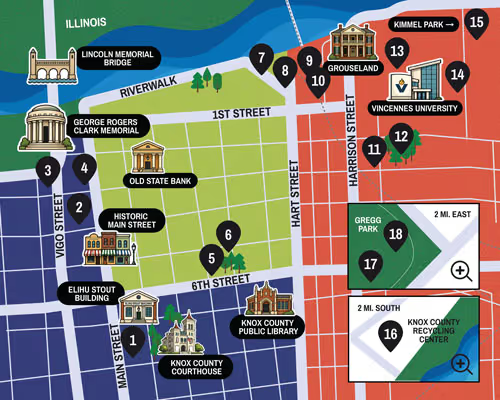
 Gregg Park
 Painted steel
- See More from this Artist

Sculpture Description
A vertically stacked arrangement of angular, flame-like steel forms, Firewalker rises in a dynamic, upward sweep. Painted in a bold, saturated orange, the layered elements pivot and extend from a central axis, suggesting motion, balance, and heat. The sculpture combines sharp planes and curved contours to create a sense of lift and forward momentum, translating the energy of fire into an abstract, ascending composition.
Artist's Statement
I wholly subscribe to the idea of making your work out of what you know. My work springs from my surroundings. Even when making abstract works, I have drawn my inspiration from a close examination of what is close at hand. Universal questions can be approached if rooted in the specific.There has to be something real to abstract from, and that something is close at hand. I am interested in place. I am interested in what happened or is going to happen in that place, whether it is yesterday or in the distant past. I am interested in what has been forgotten. I am interested in the sublime. I am interested in what is just under the surface of our present reality.
Engagement Exercise
Grade Level: 6–9
Project Title: Art from Where You Are
Objective: Explore place-based inspiration and abstraction.
Activity: Students list elements from their own surroundings—architecture, weather, local history, daily routes—and choose one to abstract into a sculptural drawing or small constructed form. Introduce the idea of site-responsive art—work shaped by awareness of place. Students present how their sculpture reflects something specific about their environment.
Sign Info
Firewalker presents a vertically stacked arrangement of angular, flame-like steel forms that rise in a dynamic upward sweep. Painted in saturated orange, the layered elements pivot and extend from a central axis, suggesting motion, heat, and transformation. Sharp planes and curved contours combine to create a sense of lift and forward momentum, translating the energy of fire into an abstract ascending structure. The sculpture balances visual tension and stability, inviting viewers to experience movement and intensity within a static form.
Ferriby describes his work as rooted in close attention to place, noting that “there has to be something real to abstract from.” The sculpture reflects a site-responsive sensibility—art shaped by awareness of environment, memory, and time—encouraging viewers to consider how past and present experiences become embedded within physical space.
-2.jpg)